
Ambiguity Aversion: Everything You Need to Know
Updated: Aug 15, 2025
Imagine you're standing at a crossroads, faced with two paths. One is well-lit, clear, and mapped out, while the other disappears into a fog of uncertainty. Which one would you choose? Most of us, if not all, would likely lean towards the known path, even if we know it might lead to a worse outcome. Why? It's not just a preference for the familiar; it's a manifestation of a cognitive phenomenon known as Ambiguity Aversion, our tendency to choose the known option, even when the unknown has the potential to be better.
The complexity of a task and differences in how individuals perceive a problem’s ambiguity are key determinants of behaviour. - Mark Ratchford.
Imagine you are asked to bet money on the colour of the ball being drawn from one urn or the other, where the first urn contained exactly 50 black balls and 50 red balls, while the second contained 100 black and red balls in an unknown ratio.
According to Ellsberg, if asked to bet money on a colour being drawn from one urn or the other, people would tend to choose the “known” bet in the first urn and avoid the “ambiguity” of not knowing the winning odds in the second urn, even if the ambiguous urn might offer a better chance of winning. People pick the worst option, knowing it’s worse, simply because it’s not ambiguous. He labelled this behaviour ambiguity aversion, noting that such an anomaly would violate the basic assumptions of subjective expected utility theory. Ambiguity aversion is our inherent discomfort with uncertainty and a preference for known risks over unknown ones — even when the known option is clearly inferior.
Causes of Ambiguity Aversion:
Fear of the Unknown: Human brains are wired to seek safety and avoid potential threats. Ambiguity triggers our primal fear of the unknown, leading us to gravitate towards known outcomes, even when those outcomes are objectively worse.
Cognitive Load: Processing ambiguous information requires more cognitive effort. The brain, in its quest for efficiency, may opt for the easier route of avoiding ambiguity altogether. Hsu et al. (2005) conducted neuroeconomic studies indicating that processing ambiguous information requires additional cognitive effort.

Loss Aversion: Research, such as the studies by Tversky and Kahneman, suggests that people are more averse to potential losses than they are inclined towards equivalent gains. Ambiguity introduces a sense of potential loss, heightening aversion, even if the ambiguous choice could result in greater gains.
Ambiguity Aversion in Daily Life:
Investment Decisions: When markets are volatile, investors may pull their money out to avoid uncertainty, even if staying invested could yield better returns in the long run. This means knowingly taking a smaller gain or even a loss, simply because it feels less uncertain.

Healthcare Choices: You may opt for familiar treatments with known side effects over experimental ones, even if the latter could be more effective. For instance, when the COVID-19 vaccine rolled out, many people avoided it due to perceived risks of the unknown, even though not getting vaccinated posed a greater risk.
Career Choices: We might stick with familiar career paths rather than explore new opportunities due to fear of the unknown. For example, with AI becoming popular, some resist adapting to it, even if embracing it could open better prospects.
Mitigating Ambiguity Aversion:
Developing Tolerance: Actively expose yourself to ambiguous situations to build tolerance over time.
Information Gathering: Seek more information and diverse perspectives to reduce uncertainty. The idea is that additional information may make the decision context less ambiguous, potentially reducing aversion.
Mindfulness Practices: Techniques like mindfulness and meditation can help manage the discomfort associated with ambiguity. A study by Kabat-Zinn (2003) suggests that mindfulness practices can enhance cognitive flexibility and resilience in the face of uncertainty.
Conclusion
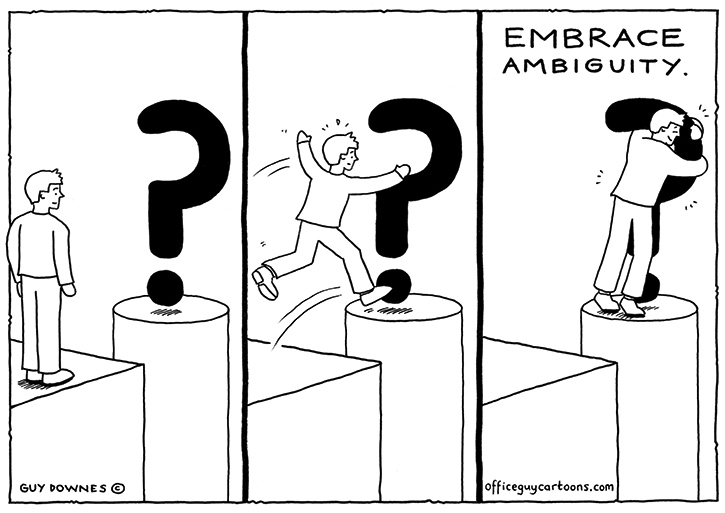
As we navigate the complexities of decision-making, acknowledging and addressing ambiguity aversion is key. It's not about eliminating uncertainty but learning to coexist with it. Embracing ambiguity opens doors to innovation, growth, and untapped potential. So, the next time you encounter the foggy crossroads, consider venturing into the unknown; the better option might be waiting there.


Comments